Empathy and Accountability—an Unlikely but Vital Combination

As a leader, I learned long ago that most people are capable of much more than their manager gives them credit for. If you are a leader who thinks this way, you probably treat your team members well—the way you would want to be treated if you were in their shoes. As you get to know each individual, you may even start to feel that you understand how they think and feel about different things. You are an empathetic leader.

When a leader has empathy for their direct reports, does it mean they will let everyone do their job in whatever way they choose? Of course not. It is the leader’s responsibility to set boundaries by keeping people accountable for their goal achievement, growth, and behavior. In other words, the best leaders not only lead with empathy, they also hold their people accountable. Both elements are critical for success in today’s organizations.

If this sounds familiar, it might be because you’ve heard me say “Servant leadership is the best way to achieve both great relationships and great results.” Being empathetic while instilling accountability in people are leadership skills that can have the same positive outcome. Leaders must hold people accountable for achieving goals, but those who focus only on results will lose their people. Successful leaders are able to create an empathetic environment where people feel seen and heard and also want to perform at a high level.

A key part of leading with empathy is being a good listener. People appreciate a manager who cares about them and what they think. One way for managers to build meaningful connections with their people is to schedule one-on-one meetings where the direct report sets the agenda. There’s no better way to get to know team members as individuals than to set aside time—just 20 to 30 minutes every other week—to chat about anything they wish. It’s a unique opportunity for a manager and a direct report to speak openly with one another without interference or judgment.

When you begin the meeting, eliminate distractions so that you will be present and focused on your team member. Demonstrate curiosity and the desire to help. Open your mind to their ideas and viewpoints. Allow the person time to think before they speak. Also, pay attention to nonverbal clues such as their tone of voice. Practice active listening by restating in your own words what the person said. Or wait until the end of the meeting when you can thoughtfully  summarize the full conversation—so that your direct report knows you empathize and understand their perspectives and experiences. Having regular one-on-one meetings leads to trusting relationships built on empathy, respect, loyalty, and accountability for everyone involved.

Remember that as a manager, the best moments you spend are the ones you invest in your people. Lead with empathy and show them they are valued by listening, letting them know you understand their needs, and always keeping the lines of communication open. They will want to do their best for you and willingly take accountability. When that happens, you’ll know you have a high performing team.

Any Dumb-Ass Can Do It: A New Book by My Friend, Garry Ridge

My good friend, Garry Ridge, has a new book out called Any Dumb-Ass Can Do It: Learning Moments from an Everyday CEO of a Multibillion-Dollar Company. I’m not surprised that it’s already a bestseller, because the book is as fun to read as it is informative. You can tell from chapters like “Even the Queen Sits Down to Pee” that Garry doesn’t take himself too seriously. Yet every chapter contains a key message about creating a safe, supportive work culture in which people can thrive. As Garry knows, when people thrive, so does the bottom line.

Don’t Mark My Paper—Help Me Get an A

I met Garry more than 20 years ago when he signed up for the Master of Science in Executive Leadership (MSEL) graduate program that my wife, Margie, and I were teaching at the University of San Diego. He had just arrived in the US from Australia to take over as president of WD-40 Company, and he thought our MSEL program would help him be a more effective leader.

A light bulb went on in Garry’s head when he heard me talk about how during my days as a college professor I used to give out the final exam at the beginning of the course and spend the semester teaching students the answers so they could get an A on the final exam.

“Why don’t we do that in business?” he asked. It made no sense to him why managers stood back and graded people instead of coaching them. So, he set up a “Don’t Mark My Paper, Help Me Get an A” performance review system at WD-40 Company that coached learners instead of punishing them. The results were spectacular; the company’s annual sales more than tripled. Garry and I wrote a book about it called Helping People Win at Work.

Investing in Leadership Development

Garry continued to implement the leadership practices Blanchard had been teaching for decades, heart-centered strategies for building trust and leading individuals and teams. By the time he retired as CEO of WD-40 Company, it was valued at more than $3 billion, with products selling in 176 countries on every continent. We were lucky to have Garry serve on the Blanchard board of directors, where we benefited from many of his powerful “learning moments”—those flashes of insight that led to better outcomes.

I’ve always said that success is about results and relationships. Garry is a living, breathing example of how a leader of a publicly traded company can succeed while caring about its people. As Garry puts it, “I love my shareholders, but I serve my people. Because if I serve my people, they will delight my customers who will in turn delight my shareholders. The vision-crushing ritual of the pressure of quarterly earnings is no measure of a company’s true, long-term success.”

Garry is no dumb-ass, of course. In fact, Inc. magazine named him as one of the world’s Top 10 Most Admired CEOs. His point is that you don’t have to have super intelligence or a fancy degree to succeed as a leader. But you must have the humility to learn, and you must genuinely care for the people in your organization. When your people thrive, they create raving fan customers who in turn support a healthy bottom line, which delights shareholders. If Garry is a dumb-ass, we need more like him in business!

Margie—The Woman Beside Me

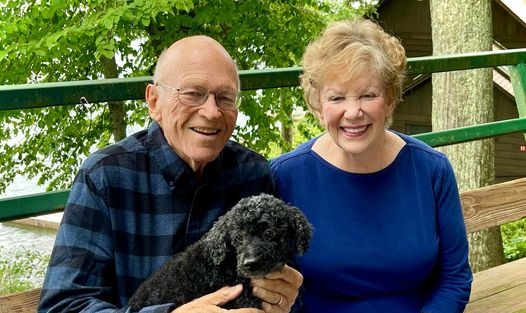
In honor of Women’s History Month, I’ve updated this blog post I wrote two years ago about my favorite woman. She is my best friend, my true love, and my brilliant, beautiful wife of nearly 64 years—Margie Blanchard.

The old saying “Behind every successful man is a woman” isn’t true in our case. Margie was never behind me—she has always been right beside me as my partner in life. I wouldn’t be anywhere without Margie. She has been the spark for many of the great events of our lives.

The Beginning

I fell in love with Margie in the summer of 1961. I had just graduated from Cornell and was hanging around town for the summer, mainly to play golf and take a couple of courses to lighten my load for the master’s program I would be starting in the fall. A friend of mine whom we all called “Looper” had been dating Margie, but his father passed away and Looper needed to go home to run the family dairy. He asked me if I would take Margie out once in a while as a favor to him. One day my roommate asked me to have a drink with him and one of Margie’s sorority sisters who was getting married soon. My roommate was going to be best man in their wedding. I said, “Okay, I’ll invite Margie McKee to join us. She’s almost married, too.”

Margie was working that summer as a speech therapist and counselor at a camp for kids with severe speech problems. I picked her up at the camp and we drove eight miles back to town. She spent the entire ride describing her feelings about these special needs children—she was so filled with compassion. She had a real heart for those kids as well as a need to help people. I think I fell in love with Margie on that eight-mile ride. We were married the following June.

My Start as an Author

In the fall of 1966, Margie (pregnant with our daughter, Debbie), our son, Scott, and I arrived at Ohio University. I had landed a job as an assistant to Harry Evarts, dean of the school of business administration. Paul Hersey had just arrived on campus as chairman of the management department, where I began teaching a course at the request of the dean. I discovered that I loved teaching.

I heard Hersey taught a tremendous course on leadership, so in December I went to see him and said, “Paul, I understand you teach a great leadership course. Could I sit in next semester?”

Paul said I was welcome to take his course, but I would have to take it for credit.

I was stunned. I went home and told Margie about the conversation.

“Can you imagine? He won’t let me audit his course. I have a Ph.D. and he doesn’t, and he wants me to take his course for credit!”

Margie said, “That’s all fine, but is he any good?”

“He’s supposed to be fabulous.”

“Then why don’t you get your ego out of the way and take his course?”

After convincing the registrar to let me take Hersey’s undergrad course, I signed up, went to class, wrote all the papers, and found it to be a great experience.

After the course ended, Hersey took me aside and asked me to write a textbook with him, which became the first edition of Management of Organizational Behavior: Utilizing Human Resources. It is still in print, now in its tenth edition.

If it weren’t for Margie’s suggestion, Paul Hersey and I would not have coauthored that book, which popularized the Situational Leadership®* model we created together.

The Birth of The One Minute Manager

In 1980, Margie and I went to a cocktail party for San Diego authors. Also at the party was Spencer Johnson, who had coauthored a series of children’s books called Value Tales with his wife, Ann Donegan. He was in the process of coauthoring a parenting book titled The One Minute Scolding. Margie met Spencer first, hand-carried him over to me, and told us she thought we should meet.

Then Margie said something that would change all our lives: “You two need to write a children’s book for managers. They won’t read anything else.”

The following week, Spencer came to see me speak at a seminar I was giving in town. He sat in the back, laughing, apparently enjoying my presentation. At the end, he came up to me and said “The hell with parenting—let’s write The One Minute Manager®!” And we did.

To date, the book has sold more than fifteen million copies. It wouldn’t have happened without Margie.

The Ken Blanchard Companies® and Beyond

During the ten years Margie spent as president of our company, I was sometimes asked why she was president, not me. I thought it was obvious that she was the one who should be president. That held true: when Margie started her term, we were a five million dollar company. When she left that position, we were a thirty million dollar company. (Margie is the first to say that partnering with her brother, Tom McKee, who joined the company as general manager of operations, was what made the difference.) As a lifelong cheerleader, I was just happy to work beside Margie and Tom and cheer them on.

Margie has always been interested in keeping an eye on business trends. She also believes leaders should keep managing the present separate from planning the future. So when she ended her term as company president, she and Blanchard cofounder Eunice Parisi-Carew created a unique, innovative think tank they named Office of the Future (OOF). With help from Margie’s assistant, Lily Guthrie, OOF studied and reported on emerging trends in leadership, technology, and other workplace issues. OOF’s findings and reports were available to clients and other organizations to assist with planning for the future, and to the media for use in advising the public of trends in the workplace. Margie saw their work and research as both a challenge to Blanchard’s status quo and a stimulus for change that would ensure our company’s continued vitality and success.

Today, Margie is as active and interesting as ever. Because Margie is a lifelong teacher, she has a special place in her heart for Blanchard Institute, our 501(c)(3) nonprofit organization that offers free Student Self Leadership training programs for students 14 to 18, with several scholarships available each year for higher education. She also loves to teach courses on career planning to young people in our company. And because Margie is a lifelong learner, when the pandemic began she took up a new hobby of watercolor painting. She’s really good!

Thank you, Margie, for being a wonderful woman and the best partner a man could ever hope to have.

*Situational Leadership® is a registered trademark of Leadership Studies, Inc., dba The Center for Leadership Studies.  

Look Forward to Looking Back at Your Goal Success in 2025

It’s time again to think about New Year’s resolutions. I like to picture myself sitting here a year from now, looking back on 2025, and patting myself on the back because I’ve accomplished three or four goals that I set for the year.

What do you dream of achieving, professionally or personally, in the next twelve months? You may want to set a work goal such as improving your time management or organizational skills, or going for a certificate or degree you need to qualify for a promotion. Or perhaps you have a personal goal regarding healthy eating or exercise habits. Do you have a desire to learn a new language? Have you been wanting to start a writing project like an article, book, or blog? Travel more? Learn to paint? Picture yourself a year from now, looking back at having accomplished one or more goals that you may have had in the back of your mind for months or years.

Personally, I’ve found the best way to write effective resolutions is to make them SMART: Specific, Motivating, Attainable, Relevant, and Trackable.

  • Specific: Be explicit about what your goal is so that it’s observable and measurable.

Example: “Eat more fish” is too indistinct to be a goal. “Eat seafood twice a week” is something I can mark on the calendar.

  • Motivating: Make sure your goal is something that excites you; something you really want to do.

Example: Even though I’ve coauthored more than 70 books, I’ve never been a big reader. I wish I were, but I’m not. I know if I made a resolution to start reading more books, I wouldn’t keep it. However, I do have a lot of old friends that I love talking with on the phone. “Call a different friend every week this year” is a resolution I would really enjoy and could easily keep. I feel satisfied and relaxed after one of those conversations.

  • Attainable: Don’t set an unrealistic goal that there’s no chance you’ll accomplish. If a resolution is too fantastic, you are just setting yourself up to fail.

Example: Even though I love going to the course and playing NATO (Not Attached To Outcome) golf with friends on a nice day, if I made a resolution to golf five days a week, I might get all tired out. Once a week is perfect for me. It still feels special and I have plenty of energy to play a decent game.

  • Relevant: Is achieving this goal important to you? Will it enhance your life?

Example: Some time ago when our company began teaching the ABCDs of Trust (Able, Believable, Connected, and Dependable), I took a Trust assessment and was surprised to learn that I wasn’t very dependable. Apparently my desire to please everyone had led to frequent overpromising, which resulted in people being disappointed because I couldn’t meet their expectations. My team helped me set this goal: When someone approached me with an opportunity, instead of saying “yes” without thinking, I would give the person my executive assistant’s business card and she would make sure I had the time and resources to follow through. My dependability score soared! I didn’t let people down anymore—and working with my team got easier, too.

  • Trackable: Chart your success over time to catch yourself doing things right, making progress, acknowledging your wins, and celebrating every step of the way!

Example: For me, sharing my resolutions with my family, friends, and colleagues makes everything more fun because I have cheerleaders and supporters that help me track my progress and celebrate even the smallest victory. An accountability group is never a bad idea if you really want to set yourself up for success.

For best results, limit the number of your goals/resolutions to between three and five. Write them down and look at them every day. Place them where you can easily see them, either on your computer’s home screen, printed out and on the wall above your desk, or in another obvious place. If you think you’ll never forget your goals or resolutions, you are wrong. There’s also a good possibility changes may happen that would require you to rewrite a goal.

In the next few days, I’ll narrow down my list of resolutions to my top five. How about you? What resolutions for 2025 do you want to be looking back on with the pride of accomplishment a year from now? Too often New Year’s resolutions are just announcements. Don’t just announce it—really make it happen! And best wishes for a wonderful 2025!

December Is for Reflecting and Dreaming

It’s December! I love this time of year. Not only do I look forward to the holidays, but I also look back at the past twelve months to take stock of the challenges I’ve overcome, the achievements I’ve celebrated, and the exciting things ahead.

If you’ve been reading my blog for a while, you might remember that I do this each year, for good reasons. I encourage you to do the same.

I’ll bet you handled some challenges that seemed daunting at the beginning of the year. By reflecting on how you managed those challenges, you will appreciate your resilience and know that you can draw on your problem-solving abilities in the year to come.

I’m sure you also had some achievements in 2024. Now is the time to take stock of them, so you can catch yourself doing something right! Take a moment to appreciate all that you’ve accomplished. Celebrating your wins, even small ones, improves your self-esteem and encourages you to take on new goals.

Finally, take some time to look toward 2025. Do you have a compelling picture of the year ahead? What do you want to be true next year that is not true today? Now is the time to dream! Dreams help you connect to your inner self and give you a sense of purpose.

I’m looking back at 2024 with amazement, because this year marked three major milestones for me.

First, I turned 85 years old! That’s an incredible blessing, especially since I’ve spent 62 of those years married to my best friend, Margie.

Second, our company turned 45 years old in 2024. This is amazing, considering that the average company lifespan is only 20 years, and less than 5 percent of companies ever reach the 40-year mark.

Finally, Lead Like Jesus, the organization I started with my college buddy, Phil Hodges, turned 25 this year.

What were the major milestones of 2024 for you? What challenges did you overcome? What achievements can you celebrate? What dreams do you have for the coming year?

Taking time to reflect on these things can deepen your appreciation for the great gift of life. Remember: Life is a very special occasion—don’t miss it!