A New Twist on SMART Goals

Business man pointing to transparent board with text: Goals forThis is the season when many companies begin to prioritize strategies for the coming year. Those strategic plans usually involve setting goals for departments as well as individuals. But how much time do you really spend defining clear, measurable goals? Most leaders agree with the importance of setting goals, but many don’t take the time to work with their people to clearly develop goals and write them down. As a result, people tend to get caught in what I call an “activity trap” where they are busy working on projects—but not necessarily the most important projects.

We’ve all heard the term SMART goals. Let’s take a closer look at each of the elements in the SMART acronym, which we define as:

S = specific

M = motivating

A = attainable

R = relevant

T = trackable

Here’s the twist: I’m going to ask you to think of this familiar acronym in a new way—as STRAM. Why STRAM? Because the most effective way to write a goal statement is to start with the Specific and Trackable elements first.

  • The leader should describe the Specific goal and when or how often it needs to be accomplished.
  • Now the leader needs to make sure the goal is Trackable.  How will progress or performance be tracked or measured?

To give you an example, take a look at these two similar goal statements.

  1. Produce monthly financial reports.
  2. Submit accurate and timely financial reports on a bimonthly basis for the next 12 months as measured by end user feedback.

Which of these is the SMART goal? The second one. Why? The first is a goal statement, but it isn’t specific or trackable. The second goal statement provides precise outcomes for accurate and timely financials on a bimonthly basis. And the results will be measured by end user reports. So the second goal is specific and trackable.

Once the S and T are in place, the leader and team member can review the other three elements—Relevant, Attainable and Motivating—to check if the goal is truly SMART.

  • The leader has the responsibility for making the goal Relevant by ensuring the goal is important and that accomplishing the goal will make a difference to the organization.
  • The leader and team member work together to make sure the goal is Attainable. It must be realistic and achievable. When a goal is too difficult to accomplish, people may give up—but when it is too easy, people tend to procrastinate.
  • Ultimately, each team member determines for themselves if the goal is Motivating by considering if it is exciting and meaningful. Will it drain energy from their work experience or add enjoyment? Will the goal help build competence, relationships, or autonomy?

If you take some time up front to write SMART goals, your team will be able to focus on the most important projects that will support not only organizational goals but also each team member’s personal needs. This will create an energized and motivating work environment that supports both great results and human satisfaction—a winning combination for success.


Bringing Out the Magnificence in Your People

john-calipariLast week I had the chance to spend time with my old friend John Calipari, coach of the University of Kentucky basketball team. I met “Coach Cal” more than 35 years ago at the University of Massachusetts when he was on the coaching staff and I was a faculty member. Through the years, our careers have both been focused on leadership skills—mine emphasizing the development of business leaders and Cal’s concentrating on leading young athletes.

I believe that people want to grow and develop, and that the job of a great leader is to bring out the magnificence in people. I can’t think of a better example of this than Cal.

As I watched Cal working with his team, I asked him about his vision for them. He said, “We’re in the life skills business. We just happen to play basketball.” What a wonderful perspective. As a true servant leader, he wants to prepare these kids for life and help them accomplish their dreams. He realizes that leadership isn’t about him; it’s about the team he serves. In his book Players First: Coaching from the Inside Out, he challenges players to be the best they can be and to help bring out the best in their teammates.

Calipari has led his team to the elusive Final Four tournament three times in the past four years. They won it all in 2012. When asked about that NCAA Championship, he replied, “It isn’t about me. It’s about these 13 players.” He truly trusts that each player has a special skill, talent, or strength and that his job is to help each individual develop to his highest level.

Although Coach Cal starts out with a new team every season and works within a specific time frame, he uses the same skills to build team after successful team. Business leaders can learn a lot from Calipari’s leadership style. All leaders should spend time with their direct reports to understand their individual strengths, help each of them realize their brilliance, and bring out their magnificence. It’s an investment that serves the individual, the leader, and the organization.

Do You Have the Heart of a Leader?

teach, inspire, motivate  - a collage of isolated words in vintaI’ve worked with thousands of leaders over the years and the most successful ones achieve results while acting with respect, care, and fairness for the well-being of everyone involved. Many companies put pressure on leaders to reach or surpass goals at any cost. But wise companies realize that leaders who can achieve results by creating a motivating work environment are the leaders who will sustain future success.

What’s the secret behind this kind of leader? I think truly effective leadership begins on the inside—with your heart. Leading from your heart is about leadership character and intention, which form the backbone of servant leadership. As a leader, you must ask yourself why you lead. Is it to serve or to be served? Answering this question in a truthful way is so important. You can’t fake being a servant leader. I believe that if leaders don’t get the heart right, they simply won’t ever become servant leaders.

The most persistent barrier to being a servant leader is a heart motivated by self-interest that looks at the world as a “give a little, take a lot” proposition. Leaders with hearts motivated by self-interest put their own agenda, safety, status, and gratification ahead of those who are affected by their thoughts and actions. Leaders with a servant heart believe their role is to bring out the best in others. They thrive on developing people and helping them achieve their goals. They constantly try to find out what their people need to perform well. Being a servant leader is not just another management technique. It is a way of life for those with servant hearts.

Rekindle, Reinvigorate, and Recharge—It Works at Any Age

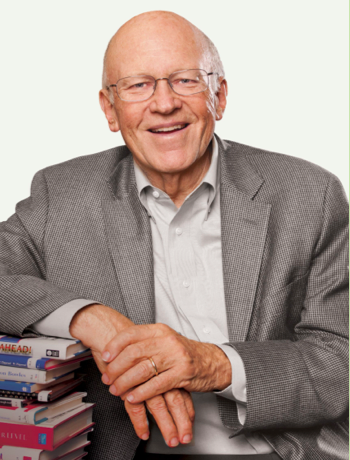
Ken BlanchardOn May 6, I turned 75 years old. In today’s society, most people would be retired at 75—or at least thinking about it.

But did you know that the very practice of retirement was designed for the industrial world? During that era, people were physically tired by the time they reached 65 and needed to rest.

Things are different now—we have more options. My goal in life is to be a loving teacher of simple truths. I’ve always searched for methods to improve the skills of leaders and to communicate those methods in a way that makes it easy for people to understand and practice. That doesn’t make me tired—it refuels me. So, I’m adopting a different approach. I’m focusing on an attitude of refirement instead of retirement.

I first heard this word from Zig Ziglar, the great American author and motivator. When he would run into friends who hadn’t seen him for a while, they would ask if he had retired. He always answered this question the same way.  “There’s no mention of retirement in the Bible. Except for Jesus, Mary and Joseph, David, and a few others, nobody under 80 made an impact. I’m not retiring, I’m refiring! I’m not gonna ease up, let up, shut up or give up until I’m taken up. As a matter of fact, I’m just getting warmed up!” Zig lived his life that way until his death in the fall of 2012.

Norman Vincent Peale was another of my mentors who helped shape this idea. When I first met Norman, he was eighty-six years old. What most amazed me about him was that he was excited about every single day. Why? He couldn’t wait to find out what he might learn. He often said, “When I stop learning, I might as well lie down because I will be dead.” He was learning right up until he passed away at age ninety-five.

Learning is more important today than it’s ever been. In the past, if people were loyal to their company and worked hard, their job was secure. Today, the skills you bring to the party constitute the only available form of job security. People who are continually learning and upgrading their skills increase their value—not only in their organization, but also in the overall job market.

So don’t count the days until you retire. Start refiring now and look for new ways to rekindle, reinvigorate, and recharge your relationship with others. I guarantee you’ll have plenty to celebrate each and every day.

NATO Golf

With spring around the corner, I find my mind turning to golf. I love to play golf. I’ve always tried to not take it too seriously and remember that it’s just a game—but I didn’t really love to play until I started to use an approach called NATO golf. In case you haven’t heard of it before, NATO stands for Not Attached To Outcome.

BallWhen you’re attached to outcome, you might be having a good game but then you hit the ball wrong and find yourself focusing on the wrong things—every move you make, every breeze, every bump in the grass. It really tightens you up and you can’t perform as well. You become fearful of your results because you believe that who you are depends on how you score or play that day.

I can’t tell you how much more fun it is to play NATO golf than to grind my teeth over the score. It doesn’t mean I’m not interested in hitting good shots or scoring well—but I know that I am not my score. I am not each shot. As a result, I’m much more relaxed and able to swing freely at the ball without fear. I play so much better when I’m not worried about whether I’m going to be able to hit that hole or make that putt. I just get up there and let it happen. It’s beautiful.

Golf is always interesting to me, because I believe golf is a lot like life. Think about it. Sometimes you’re playing better than you should, so you learn how to deal with success.  Sometimes you’re playing worse than you should, so you learn how to deal with failure.  Sometimes you get good breaks you don’t deserve and sometimes you get good breaks you do deserve.  Sometimes you get bad breaks you don’t deserve and sometimes you get bad breaks you do deserve.  All in four and a half hours!  Ha! And one of the best ways to get to know somebody is to play golf with them and watch how they behave. It says a lot about a person.

In life, as in golf, sometimes we get so focused on outcome that we don’t enjoy the ride.  We’re so uptight about the importance of the outcome that we miss the dance of life, the dance of relationships, the dance of the sales call, or the dance of doing a seminar.

Mark Twain said, “Golf is a good walk spoiled.” I can’t say that I agree. Golf is a wonderful game as long as you don’t start believing that who you are is dependent on how you score. Don’t get attached to outcome—just be who you are and you will be amazed at how much more you’ll enjoy the game of golf—and the game of life.