Building Collaboration with Open and Honest Communication

Effective communication is the lifeblood of an organization, so it is critical for leaders to create a safe and trusting environment where people can share information freely. In our new book, Collaboration Begins with You: Be a Silo Buster, my coauthors Jane Ripley and Eunice Parisi-Carew and I offer tips for listening, giving feedback, and encouraging people to seek information and ask questions.

We use the UNITE acronym to introduce the five key elements needed to build a collaborative culture: Utilize differences; Nurture safety and trust; Involve others in crafting a clear purpose, values, and goals; Talk openly; and Empower yourself and others. In this post, let’s look at the importance of Talking openly.

As a leader, you probably already support your staff by working with them to create clear goals, supporting them, and removing roadblocks that hinder their ability to get things done. I hope you also praise them for their progress toward goals and redirect them when they get off course. But other components of communication need attention, too. Collaborative leaders need to develop their listening skills to truly understand what their direct reports are saying and to determine whether underlying issues exist. I suggest leaders also have an open door policy to encourage spontaneous interaction where people can speak candidly and ask questions. In turn, leaders must share all relevant information, give constructive feedback, and be open to receiving feedback from others. This kind of clear, honest communication will build the respectful and trusting environment necessary for a collaborative culture.

Think about how you interact with colleagues and your team. Now ask yourself these questions.

  1. Do others consider me a good listener?
  2. Do I share information about myself with my teammates?
  3. Do I seek information and ask questions?
  4. Do I give constructive feedback—and am I open to receiving feedback?
  5. Do I encourage people to network with others?

If you answered yes to these questions, you have probably created a trusting environment where people can talk openly. But pay attention if you answered no to one or more questions—because that’s where you need to start improving your skills on your way to become a collaborative leader.
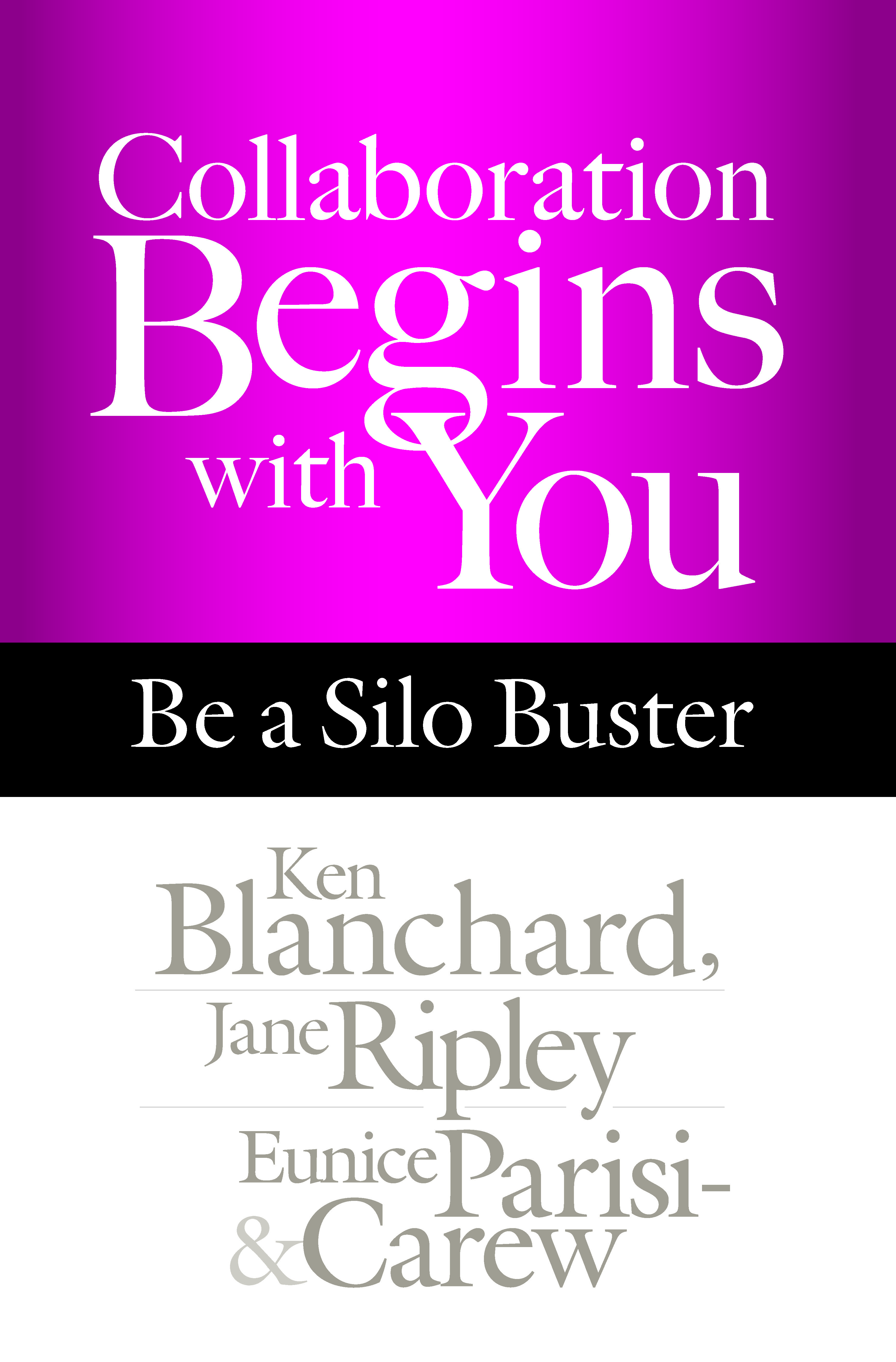
Collaboration Begins with You Book coverTo learn more about Collaboration Begins With You: Be a Silo Buster, visit the book homepage where you can download the first chapter.


The Collaborative Way to Create a Clear Purpose, Values, and Goals

I’ve always said that leadership is about going somewhere—and a big part of that is working with your people to create a clear purpose, values, and goals. This is a key element in the collaborative process we describe, using the acronym UNITE, in my latest book with my coauthors Jane Ripley and Eunice Parisi-Carew, Collaboration Begins with You: Be a Silo Buster.

As a reminder, UNITE represents the five elements every person must adopt if they want to create a culture of collaboration in their workplace: Utilize differences; Nurture safety and trust; Involve others in crafting a clear purpose, values, and goals; Talk openly; and Empower yourself and others. Today we will take a closer look at the importance of Involving others in the process of creating a clear purpose, values and goals. To clarify, a clear shared purpose galvanizes action, values guide behaviors, and goals focus energy.

It is the responsibility of the leader to ensure that the vision and direction are clear, but it is essential to get feedback from everyone when writing the purpose statement, operating values, and strategic goals. If these decisions are made by executives and imposed on the group in a top-down implementation, people won’t be wholly supportive. When everyone has input there is greater support and buy-in because each person has a stake in the outcome. Involving people in these decisions builds their commitment to the cause—whether it is at the corporate, department, or team level.

Once the purpose statement is created, team members need to agree on values and rank them in order of importance. This is a critical step because sometimes values can be in conflict with each other. For example, let’s say your values are integrity, relationships, success, and creativity, ranked in that order. Your team has come up with a very creative idea, but implementing it would be cost prohibitive and could put the company at financial risk. Since success is ranked before creativity, the project would be a no-go—that is, unless the team can be creative enough to develop a way to make the project a less expensive undertaking.

The last task is to agree upon three or four key goals that clearly state what is expected of the team. Some leaders make the mistake of thinking that when the purpose and values are clear, people will understand what they need to do. But that is a dangerous assumption to make. Don’t leave anything to chance. Clear goals are necessary to ensure everyone is moving in the same direction for the same reasons.

As a leader, how well do you think you involve others in crafting a clear purpose, values and goals? Ask yourself these questions.

  1. Is my team committed to a shared purpose?
  2. Do I know the purpose of our project and why it is important?
  3. Do I hold myself and others accountable for adhering to our values?
  4. Do I check decisions against our stated values?
  5. Do I hold myself and others accountable for project outcomes?

If you answered yes to most of these questions, you are probably a very collaborative leader. Use this checklist as a guide to make sure you are focused on continual improvement and keeping your team involved.

Collaboration Begins with You Book coverTo learn more about Collaboration Begins With You: Be a Silo Buster, visit the book homepage where you can download the first chapter.

Set Boundaries for an Empowered Workforce

Setting boundaries to help empower people might sound like a contradiction. When managed correctly, though, well placed boundaries can ensure a strong culture of empowerment for your entire company.

I’ve often said that a river without banks is a large puddle. If you empower people by setting them loose without any direction, they can lose momentum and focus—or, even worse, they can make costly mistakes or put a project at risk. Like the banks of a river, properly set boundaries will channel energy in the right direction so that people can take on more responsibility as they grow and develop.

The key to setting boundaries is to ensure people know the areas where they can be autonomous and responsible rather than focusing on things they are not permitted to do. Boundaries are based on each person’s skill level and are meant to help the person understand how their goals align with the overall vision and goals of the organization. Helping people see how their work fits into the big picture allows them to become peak performers.

It is also important for managers to explain the decision making process in an empowered culture. Some people think being empowered means they get to make all the decisions. They could be disappointed when the manager continues to make strategic decisions and leaves only some operational decisions to them. And they might hesitate to make decisions at all when they realize they will be held accountable for the results—both good and bad.

Yes, empowerment means people have the freedom to act, but it also means they are accountable for results. The right balance is to have managers continue making strategic decisions and get team members involved in making more operational decisions as they become more comfortable with assuming the potential risks involved. As people gradually accept more responsibility for decisions and consequences, managers can pull back on their involvement.

It takes a little time in the beginning for managers to establish boundaries for team members, but this investment has a huge payoff. The worst thing a manager can do is to send people off on their own with no clear direction and then punish them when they make mistakes. Don’t fall into that trap. Establish clear boundaries that will empower people to make decisions, take initiative, act like owners, and stay on track to reach both personal and organizational goals.

The Reality of Work-Life Balance

Much has been written about work-life balance. Some say it is impossible to find in our fast-paced world. Others say it is achievable—but you have to work at it.

Summertime is usually the time of year when people try to concentrate a little more on work-life balance. However, I don’t see balance as just a summer project. In fact, for some people, summers can be more hectic than the rest of the year with children out of school, extended visits from family and friends, and pressure to take vacation—even as project deadlines pile up at work. This kind of schedule can turn a balanced summer into a stressful summer. But there is a way to manage all the day-to-day demands of a busy life, no matter what time of year.

Reaching balance in life is all about decreasing stress by focusing on things that create a sense of contentment. Several years ago my lovely wife, Margie, came up with PACT—an easy to remember model whose elements can help people relieve stress in their lives by achieving Perspective, Autonomy, Connectedness, and Tone.

  • Perspective is about seeing the big picture of life. If we know our purpose and direction in life, chances are we have a good perspective and daily stressors don’t get blown out of proportion. To illustrate the concept of perspective, I think about when our kids were young and we would take them to the zoo. Most parents get a little crazy chasing their kids around the zoo, but we loved it because our top priority was to have fun with the kids. We were able to overlook certain things and just enjoy the day—it was all part of our perspective. I called it zoo mentality. Honestly, it still seems strange to me that parents take their kids to the zoo then spend the whole time yelling at them. Everyone would have more fun if they embraced the perspective of zoo mentality.
  • Autonomy relates to our ability to make choices that allow us to be in control of our lives. If you have a high sense of autonomy, you are not totally controlled by your job, your spouse, your children, or anyone or anything. Of course no one can always be in complete control of every aspect of their life, but as long as your daily activities support your personal and professional goals you will have a greater sense of balance.
  • Connectedness is all about having strong positive relationships at home, at work, and in the community. Mutually supportive relationships can enhance a feeling of overall well-being and balance. Creating trusted connections at work helps improve morale and performance, while spending quality time with family and friends leads to a feeling of satisfaction of belonging to a community or being part of something bigger than yourself.
  • Tone covers how you feel about yourself physically. It includes the way you look, your health and energy level, and your level of fitness.  People with high tone generally have a high energy level, maintain a proper weight, have sound nutrition, and feel good about their physical appearance.

Margie and I have taught the PACT model for many years, and I still use it to monitor the balance in my own life. It’s a great tool that will help you not only pinpoint what’s wrong when life gets stressful, but also check off what you’re doing right when you are feeling great.

When your life is in balance, stress naturally loses its grip. Start using the PACT model this summer and keep it up all year long. You’ll live life at a higher level.

Rekindle, Reinvigorate, and Recharge—It Works at Any Age

Ken BlanchardOn May 6, I turned 75 years old. In today’s society, most people would be retired at 75—or at least thinking about it.

But did you know that the very practice of retirement was designed for the industrial world? During that era, people were physically tired by the time they reached 65 and needed to rest.

Things are different now—we have more options. My goal in life is to be a loving teacher of simple truths. I’ve always searched for methods to improve the skills of leaders and to communicate those methods in a way that makes it easy for people to understand and practice. That doesn’t make me tired—it refuels me. So, I’m adopting a different approach. I’m focusing on an attitude of refirement instead of retirement.

I first heard this word from Zig Ziglar, the great American author and motivator. When he would run into friends who hadn’t seen him for a while, they would ask if he had retired. He always answered this question the same way.  “There’s no mention of retirement in the Bible. Except for Jesus, Mary and Joseph, David, and a few others, nobody under 80 made an impact. I’m not retiring, I’m refiring! I’m not gonna ease up, let up, shut up or give up until I’m taken up. As a matter of fact, I’m just getting warmed up!” Zig lived his life that way until his death in the fall of 2012.

Norman Vincent Peale was another of my mentors who helped shape this idea. When I first met Norman, he was eighty-six years old. What most amazed me about him was that he was excited about every single day. Why? He couldn’t wait to find out what he might learn. He often said, “When I stop learning, I might as well lie down because I will be dead.” He was learning right up until he passed away at age ninety-five.

Learning is more important today than it’s ever been. In the past, if people were loyal to their company and worked hard, their job was secure. Today, the skills you bring to the party constitute the only available form of job security. People who are continually learning and upgrading their skills increase their value—not only in their organization, but also in the overall job market.

So don’t count the days until you retire. Start refiring now and look for new ways to rekindle, reinvigorate, and recharge your relationship with others. I guarantee you’ll have plenty to celebrate each and every day.