
What Principles Are on Your Belief Window?

Many years ago, my late, great friend Hyrum Smith was a member of a team that discovered the Reality Model, a brilliant visual way of describing how people look at life. Hyrum was so taken by the concepts in the model that he spent much of the rest of his life traveling around  and spreading the life-changing message to businesses, schools, churches, and even prisons. The ideas in the model aren’t new, but they are remarkably relevant for today. Why? Because the Reality Model helps people see the world as it really is.

The main concept of the Reality Model is the idea that each of us has a Belief Window through which we observe the world around us. On our Belief Window are thousands of principles we believe to be true about ourselves, our world, and other people. Most of these principles are an attempt to meet a basic human need such as to live, to love and be loved, to feel important, or to have variety. Some principles, such as “the Earth is round,” reflect reality, and some, such as “dogs are better than cats,” are subjective. Either way, we believe them to be true and we will behave as if they are—because our beliefs drive our behavior.

That said, the key to effective living is to continually identify the changing principles on our Belief Windows, look at the results they give us, and ask an important question: Will these results meet my needs over time? If the answer is yes,it usually means it is a valid belief for us. If the answer is no, we can chalk it up as a lousy belief and choose to either get rid of it or change it.

Let me give you a personal example. I once found myself tipping the scale at more than thirty pounds over my normal weight. My wife, Margie, asked me what my philosophy of eating was—particularly when I was consulting and teaching on the road. I answered, “If I’ve been working hard, I deserve to eat anything I want at night.” She said, “So how is that working for you?” I had to admit, it wasn’t fun carrying around the burden of that extra weight. These results weren’t meeting my needs over time. I needed to make a change.

Now remember: beliefs drive behavior. I realized that before my behavior could change, what I believed about eating had to change. I had to find an alternative principle. After much thought, I came up with this: “If I’ve been working hard, I deserve to eat a healthy dinner so I can sleep well and feel good about myself.” My revised principle helped me, over time, to get the results I wanted—and evaluating my Belief Window was instrumental in helping me turn my health around.

Why am I sharing these thoughts with you today? In the past eighteen months, we all have been carrying around the burden of living through a pandemic. Each of us has faced our own challenges—physical health, mental health, jobs, finances, etc. Many people’s lives have been turned upside down in too many ways to count. I’d like to suggest we all take a look at the principles that have formed on our Belief Windows and determine whether or not they have been meeting our needs over time.

For example, let’s say you have this principle on your Belief Window: “I’m afraid to leave the house. The world is a scary place.” Is that a lousy belief or is it a valid belief? Have the results of your behavior met your needs over time? If they haven’t, perhaps you could adopt an alternative principle that would meet your needs better. How about this: “Walking my dog after breakfast is a safe way for me to get back into life.” Will that alter your behavior in a positive way? Yes, it will.

Or maybe there’s been a change in what is important to you: “I’m not looking forward to going back to my office. Working from home makes me happier and I get more work done.” Is that a lousy belief or a valid belief? Have those results met your needs over time? If you think they have, talk to your supervisor—perhaps you can make working from home a permanent choice.   

When you discover that certain principles have helped you find peace of mind, hold on to them. When you uncover beliefs that haven’t been working for you, get rid of them or come up with alternatives that can help you change your results for the better. And don’t forget the phrase over time—because results take time to measure.

Are the results of your beliefs and behavior meeting your needs? Following this model won’t improve everything overnight. But becoming aware of your principles and applying the concepts of the Belief Window may be a step in the right direction.
Training Plus Coaching: A Formula for Success

Several years ago, someone asked me a thought-provoking question: “What has been your biggest disappointment in your career?” After careful reflection, it occurred to me that what bothered me most was that while my books were widely read and our training programs were used around the world, people were not following through on the concepts and using them consistently in their day-to-day work.

Why not? I wondered.

When Training Doesn’t Stick

It’s not that people didn’t care or weren’t motivated to apply the learning. It’s just that, despite their most sincere efforts, what they were learning just wasn’t sticking.

People would go to an expensive training, get inspired, and vow to apply the learning. Then they would get back to the office. Soon their notes from the training would be buried under a pile of work. Perhaps they would even try to apply some of the training. But because they were not yet good at the skills, the outcome of their efforts would be neutral or even negative. The newly trained people didn’t really have time to figure out why, so they would write off the training and go back to their old, not-so-great way of doing things.

It bothered us that the investments organizations were making in training were going down the drain.

Coaching Can Bridge the Gap

We realized that to bridge the gap between what people knew—all the good advice and tools they had learned in training—and what they did with this knowledge, people needed more support.

We have found that the best way to help people retain and apply what they learn is to integrate coaching with training. We recommend enrolling participants into a minimum of three coaching sessions after a training. In each session, the coach has focused conversations with the participant to help them tailor their new knowledge to their own work scenarios.

Sometimes even the smartest students miss key insights. Madeleine Blanchard, cofounder of Blanchard Coaching Services, recalled working with the president of a company who had just taken our SLII® leadership training. The program teaches leaders how to diagnose the development level of their direct reports on each goal and task and apply the appropriate leadership style.

The president was eager to become a role model for SLII® leadership—someone who knew exactly what each person on his team needed to succeed.

“Do you have clear goals and tasks for each direct report?” Madeleine asked in her first session with the president.

The answer was no. In his eagerness to master all the other content, the president had forgotten the first step in the training: goal setting. That kind of oversight is common—and is exactly why coaches can be invaluable in helping people apply what they’ve learned.

Where AI and Virtual Coaching Fall Short

Lately, artificial intelligence has been making a big splash in the training industry. Although AI technology offers some benefits, when it comes to making training stick, there’s nothing as effective as working with another warm-blooded, breathing human being.

There’s no big mystery to that. If you’ve ever done a physical fitness or weight loss program, you know how much more effective it is to answer to a personal trainer or classroom instructor than an unfeeling, computer-generated coach.

No matter how sophisticated AI becomes, a virtual coach can’t prepare people for all the variables they will encounter when they try to put their training into practice in the workplace. It can’t hold people accountable to their commitment to apply the training. And there’s no way a virtual coach can take the place of a human when it comes to acknowledging, praising, and celebrating progress.

It’s human nature to be motivated by positive feedback from others. “After our coaching sessions, people often get back to me about how they’re applying the training,” says Madeleine. “A common email I get is, ‘You are going to be so proud of me.’”

Coaching: An Investment with Long-Term Rewards

The investments organizations make in training are not intended to end when people leave the classroom. In fact, that’s just the beginning. The hope is that the benefits from the training will accrue to the bottom line over the long term.

A small additional expenditure in follow-up coaching assures that an organization’s training investment will pay dividends well into the future. If the cost of one-on-one coaching is prohibitive, small group coaching can also be effective. So, start integrating follow-up coaching with your training. You’ll be amazed at the results!

Embracing Reality—and Mud—Is Better than Fighting it

We just had a fabulous wedding weekend at a place Margie and I call our “Farm” near Skaneateles Lake in upstate New York. The Farm is a five-acre plot of land, mostly lawn, with a house and a few outbuildings where we store family cars, boats, and other equipment when we aren’t in town.

Because of the beautiful view and the peaceful setting, our granddaughter, Hannah, and her devoted partner, Beth, decided the Farm was the perfect spot for their wedding and reception.

On the East Coast, the greatest unknown for summer weddings is the weather. It had been raining in central New York for almost two straight weeks and the forecast was for a wet wedding day. Our son, Scott, and daughter-in-law, Madeleine, not only had warned 130 guests to seriously consider their footwear, they had filled a big basket with Old Navy flip-flops for people to use and take home.

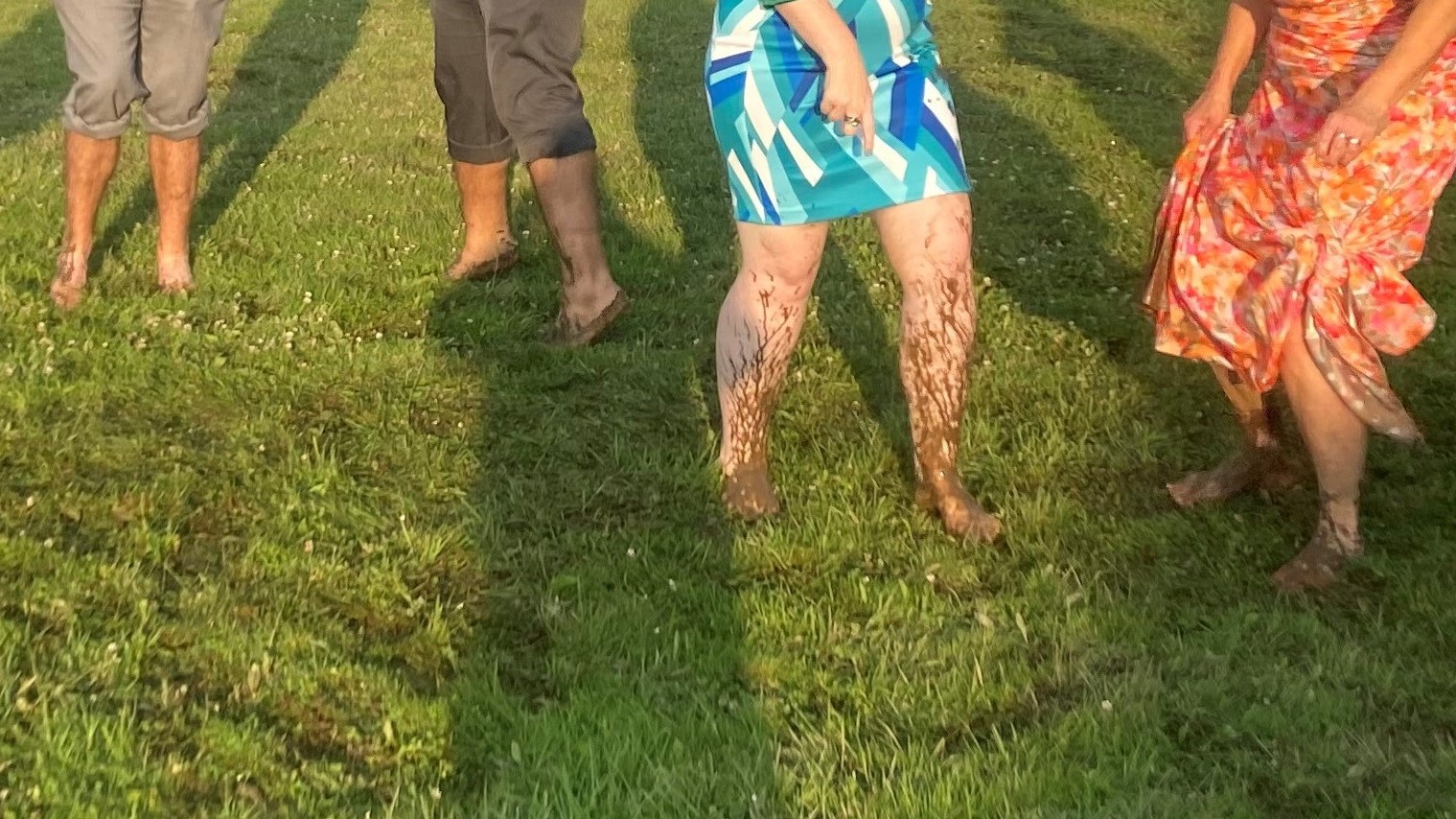
But on the day of the wedding, as our two families were gathering for pictures before the ceremony, the rain amazingly stopped. The sun gradually came out from behind the clouds during the reception—and the organizers opened the flaps of the big tent. This motivated a number of wedding guests to take off their shoes, walk out into the sunshine, and dance on the muddy grass! They had a ball and the rest of us had a lot of fun watching them.

In Scott’s words, “We were concerned that all the mud would dampen the fun. Instead, it had the opposite effect. Once the band started, people not only dealt with the mud, they embraced it. The dance floor spread from the tent to the muddy lawn. The way our guests danced in the mud was a beautiful demonstration of how resilient people can be when they decide to embrace, rather than fight, the reality they find themselves in. We had been so worried about the mud ruining the wedding—and yet the opposite occurred. No one will forget it.”

When I offered the prayer earlier at dinner, I emphasized one of my favorite sayings, “Love is the answer—what is the question?” The reason I did it was clear: all the festivities around this wedding were about love. Watching our families come together in such a joyous way was heartwarming. And there’s nothing more endearing than two people feeling unconditional love and support from their family and friends as they say their wedding vows. What a wonderful way to begin a new life together.

Whatever the question, love is the answer. And a little mud doesn’t hurt!

Leading through a Seismic Shift

As the pandemic fades, people are returning to a new, hybrid workplace—where some are working from home and others are back in the office. To guide leaders through in this unfamiliar territory, our company has been offering a series of free, helpful webinars. You can sign up for them here.

Whether we want to admit it or not, our organizational cultures have changed over the last 15 months. The old rules no longer apply and the new rules, it seems, are up for grabs.

Harnessing the Power of Your Organizational Culture

In the new, hybrid work environment, how do leaders get the support of their employees and return to pre-pandemic levels of performance?

New York Times bestselling author Stan Slap provides lots of great ideas in the first webinar of our five-part series, “Back to Better: How to Return Your People, Purpose, and Performance.”

“This is not a physical relocation issue,” says Stan. “This is a cultural commitment issue.” Stan is a lively and entertaining guy, so it’s fun to watch him explain how leaders must work with the existing organizational culture to create predictability, energy, and a sense of belonging and relevance.

He also expresses the importance of the human connection: “Be a human first and a manager second.” Great advice!

Taking Advantage of a Rare Opportunity

In the second seminar in our Return to the Workplace Series, “Vision & Execution: Making the Most of an Opportunity to Change Your Organization,” Scott Blanchard makes an important point: this moment in time presents a rare opportunity for leaders to influence their organizations.

“Right now, return-to-work is a critical strategic mission for almost every company out there,” Scott says. He stresses that now is the time for leaders to step up.

“Leaders might be underleading the return to work,” he continues. “Our company’s research reveals that up to 75 percent of people report needing more direction from their leaders, not less.”

Scott points out that good things rarely happen by accident. “When good things are happening in an organization—from a Girl Scout troop all the way up to a nation state—it’s always a leader who is responsible for creating that positive momentum. And whenever things are not going well, the leadership of the organization is a part of that situation.”

Creating an Engaging Picture of the Future

The world has changed in the past year and a half, and your organizational vision and return-to-work strategy need to reflect that.

Scott stresses how important it is for leaders to take concrete steps and pivot to the future. “Peter Drucker said that the only things that happen naturally in organizations are inefficiency, friction, and political mayhem. This is especially true in an environment where things are changing.”

So, what is the solution to the potential chaos in your organization?

“Success requires a vision, a plan, and the tenacity to stick with the plan,” says Scott. “First, create an engaging picture of the post-pandemic future that excites people and inspires them about your mission. Next, help people see how their current roles and responsibilities connect to that vision.”

Leading Successful Change Requires High Involvement

Leaders cannot pull off successful change strategies without the support of their people. That’s why it’s so important for leaders to be other focused rather than self-focused. What do your people need to deliver on the vision and plan? What are their concerns? Are you listening to their feedback, including them in decision-making, and staying involved as the plan moves forward?

Research shows that top-down change—where leaders do little more than set the strategy—is often doomed to failure. Yet more than 80 percent of organizations still manage change from the top down.

An Epic Shift

Transitioning to the hybrid workplace “is an epic shift of millions of people,” Scott concludes. Now more than ever, your behavior as a leader matters. Your people want to know: “Does my leader have my back?” If the answer is no, they will become disengaged, and your strategy is likely to get derailed. If the answer is yes, this can be an exciting new chapter for you and your organization.

Learn More in Our July 7 and July 21 Webinars

What’s the best way to communicate in the new, hybrid workplace? How do you regain people’s trust and support? Find out in our next two complimentary webinars. To register, use this link: https://www.kenblanchard.com/Events-Workshops/Returning-to-Workplace-Series.

Celebrate Your People as They Come Back to the Workplace

It was a long time coming! When California dropped most of its COVID restrictions, our company decided to have a celebration at our corporate headquarters here in Escondido. We wanted to bring everybody—over 100 people—back together for three reasons:

  1. First and foremost, everyone, everywhere, has been through a pretty rough 15 months. We wanted to give our people an opportunity to get together, face to face, and see that it could be done in a fun and safe way. To respect everyone’s individual feeling of safety, we used a unique approach where each person wore a colored wristband that indicated their comfort level. Those who wanted to keep a six-foot social distance wore a red wristband. People who preferred an elbows-only distance wore yellow. And those of us who wore green bands were basically saying, “Come on in for a hug!”  
  2. We’ve made a lot of changes to our physical office areas during everyone’s work-from-home time, so we gave tours to anyone who asked. Our fabulous Campus Comeback Team—led by the one and only Shirley Bullard, our CAO—redesigned, remodeled, and redecorated most of our office spaces. We are so proud of our beautiful new open space designs where people can safely work together in person.
  3. There’s something about “breaking bread” together that brings out that real family atmosphere. Because everyone needs to eat, we hosted a made-to-order taco grill in the parking lot with beer and sodas for all and plenty of tables and chairs that made it easy to munch and mingle. It reminded us of the fun we’ve had together at past events and got us excited about today—and tomorrow.

Even though many of our people are not coming back to the office full-time, most will be back at least once or twice a week. Starting out our “new normal” with a successful, well-attended celebration was a great way to show everyone that our offices are back in business—even though everyone has been working harder than ever all this time. It’s okay to come back. It’s still the same place. Welcome!

So how is your organization bringing people back to the workplace? Make sure people feel welcome by bringing them back in a way that lets them know how important they are and how glad you are to see them again.

If you’re not yet sure how to tackle the challenges of bringing people back to your workplace, we have some great content for you to read and watch in our newly updated Returning to the Workplace Resource Center Stream. For even more information, catch our free Returning to the Workplace webinar series featuring luminaries like culture expert Stan Slap on employee culture and commitment; Craig Weber, author of Conversational Capacity, on candor and curiosity; Blanchard president Scott Blanchard on setting a vision and leading people through change, and trust expert Randy Conley on accelerating trust during times of change. Lots of free information you can use to help your organization make your people feel special!