
Elect Servant Leaders

(This is the tenth installment in my twelve-part blog series A Leadership Vision for America.)

Now let’s look at the fourth and final secret for fixing Washington. This secret will encompass and bring to life the first three secrets.

The Fourth Secret: Elect Servant Leaders

Assumption: The more that our leaders are in Washington to serve and not be served, the better chance we have to mend what’s wrong with our country.

The world is in desperate need of a different leadership role model. Everyone has seen the negative effects of self-serving leaders in every segment of our society. In fact, to a great extent, the whole economic downturn has been the result of self-serving leaders through the years who thought all the money, recognition, power, and status should move up the hierarchy in their direction, and everyone else be damned.

Yet, when I mention servant leadership to people, they often think it means the inmates are running the prison, or trying to please everybody, or even some type of religious movement.  They think you can’t lead and serve at the same time. Yet you can, if you understand that there are two parts to servant leadership:

  • A visionary, or strategic, role—the leadership aspect of servant leadership
  • An implementation, or operational, role—the servant aspect of servant leadership

The first secret for fixing Washington—having a compelling vision—was focused on the visionary/strategic, or leadership, aspect of servant leadership. Once an organization has a compelling vision, they can set goals and define strategic initiatives that suggest what people should be focusing on right now. With a compelling vision, these goals and strategic initiatives take on more meaning and therefore are not seen as a threat, but as part of the bigger picture.
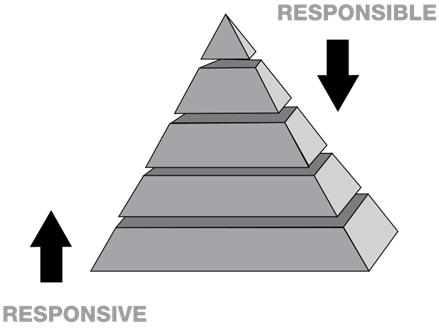
The traditional hierarchical pyramid is effective for the leadership aspect of servant leadership. People look to their organizational leaders for direction, as Americans look to Washington. While leaders should involve experienced people in shaping vision/direction, goals, and strategic imperatives, the ultimate responsibility remains with the leaders themselves and cannot be delegated to others.

Implementation/operational leadership, or the servant aspect of servant leadership—living according to the vision and direction—is where most leaders and organizations get into trouble. With self-serving leaders at the helm, the traditional hierarchical pyramid is kept alive and well, leaving the customers uncared for at the bottom of the hierarchy. All the energy in the organization moves up the hierarchy as people try to please and be responsive to their bosses, leaving the customer contact people to be “ducks,” “quacking” and saying things like, “It’s our policy,” “I just work here,” “I didn’t make the rules,” or “Do you want to talk to my supervisor?”
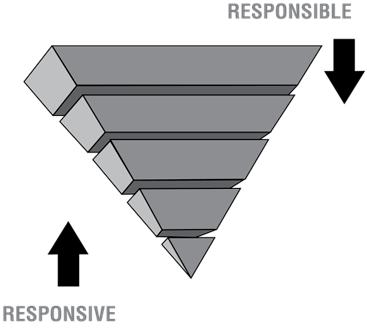
Servant leaders, on the other hand, feel that their role is to help people achieve their goals. They intuitively know that effective implementation requires turning the hierarchical pyramid upside down so the customer contact people are at the top of the organization and can be responsible—able to respond and soar like eagles—while leaders serve and are responsive to the needs of their people, helping them to accomplish goals and live according to the vision/direction, goals, and strategic imperatives of the organization.

Since the customer contact people are “in the know,” they see themselves as your responsible business partners and, therefore, are committed to not only serving customers but to solving problems. This is what the second and third secrets of fixing Washington are all about:  We must treat our citizens as our business partners and involve all segments of society to solve our problems.

To wrap up my Leadership Vision for America series, I’ll have some final thoughts for you next time and then a special message on November 3. Let me know what you think!

Bounded Set Thinking vs. Centered Set Thinking

(This is the ninth installment in my twelve-part blog series A Leadership Vision for America.)

In my last post I stated that business and government can’t solve all of America’s problems by themselves. Ideally, our leaders in Washington would involve every sector of society in problem solving. The three sectors encompass nine different domains:

  • The Public Sector, represented by government, military, and education
  • The Private Sector, represented by business, arts/entertainment, and media
  • The Social Sector, represented by the faith community, nonprofit organizations, and families

When Eric Swanson and Sam Williams were working on their book To Transform a City, they come across a very interesting philosophy about problem-solving relationships. Paul Hiebert from Fuller Seminary discovered in the 1970s that when people come together to solve a problem, they often have a “closed circle” philosophy, or what he called a Bounded Set. A bounded-set thinker asks the question, “Do you believe like I believe?”  This becomes a divisive question because it separates those who are in from those who are out, limiting people who are allowed to work on the problem to those who sign off on an agreed-upon belief.  Whether it’s political, religious, or some other type of personal conviction—unless you believe what we believe, you can’t work on the problem. This philosophy doesn’t work because it is exclusive, not inclusive. The weeding-out process continues, the circle keeps getting smaller, and the problem doesn’t get solved.

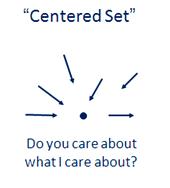
A more productive way to look at problem-solving relationships is an open philosophy Hiebert referred to as a Centered Set. A centered set has no boundary that defines who is in and who is out. The question that determines if you are part of the problem-solving group is, simply, “Do you care about what I care about?” This philosophy works because it is inclusive of all belief systems and focuses on the matter at hand: Are you concerned about the problem we want to focus on?

How would this work in Washington?  It would be the job of the president and the legislature to first identify the key problem areas that need to be focused on to help keep America prosperous and safe. Next, they would select key people from each of the nine domains, whether inside or outside their own ranks, who care about each of the areas selected. Each of these groups would work with other American citizens to develop strategies to solve each of the key problems or concern issues going forward.

The people working together could have all different kinds of personal convictions about things as long as they were all passionate about the key problem area they were working together on—whether it be the economy, homeland security, unemployment, affordable housing, balancing the budget, improving the educational system, or another important issue.

Identifying leaders from each of the domains to work on each problem highlights the fact that no one segment of the population can solve all of America’s problems. In fact, one of my favorite sayings is, “None of us is as smart as all of us.”

A perfect example of someone who lived and breathed this philosophy was William Wilberforce, who helped stop slavery in England. It took twenty years. He traveled the country on horseback and got to know key leaders from all of the different domains. He didn’t care what they believed politically, religiously, or economically—all he asked the leaders was whether they agreed with him that slavery was wrong.  If they agreed, he would help them determine how they could influence important people within different segments of society and get them on the “stop slavery” bandwagon. This led to a number of people from diverse backgrounds coming together to put an end to slave trading and ultimately abolish slavery in their country altogether.

This is the type of process our government leaders need to put into action to deal with today’s pressing issues. Right now, Washington seems to be dominated by the bounded-set philosophy, where “you have to believe what I believe” to even begin to work together on a problem, let alone agree on a solution. So you have one big bounded-set group, the Democrats, at odds with another big bounded-set group, the Republicans.

The only way to get anywhere is through compromise. What makes this third secret for fixing Washington so powerful is that it focuses on sustained collective action by all segments of society.

Next time I’ll bring it all together with the fourth secret for fixing Washington, which involves a practice that’s near and dear to my heart:  servant leadership.

Happy Employees = Happy Customers

I recently had a wonderful experience working with the founder and the head of leadership for a wonderful healthcare company in the Midwest whose main focus is elder care. It was inspirational to be with leaders who understand that the most important customer they have is their employees. They really want their employees to be excited about giving the absolutely best, most legendary service. The elder healthcare industry has tried hard to change a less-than-stellar reputation caused by news reports over the years of some facilities mistreating patients. But this organization has a great reputation for serving their patients. The workers respond to the needs of the patients and maintain an atmosphere that is stimulating and exciting for them. Continue reading

Coach Calipari: A Winner and a Servant Leader

The world is in a desperate need of a different leadership role model. Everyone has seen the effects of self-serving leaders in every aspect of our society. What we need today are leaders who are servant leaders.

When people hear the phrase servant leadership, they are often confused. They immediately conjure up thoughts of the inmates running the prison, or trying to please everyone. Others think servant leadership is only for church leaders. The problem is that they don’t understand leadership. They think you can’t lead and serve at the same time. From my experience, not only is it possible, it’s the only way over the long run to get great performance and human satisfaction. To prove my point, I’m always looking for good servant leader examples. Continue reading

How the Leadership-Profit Chain Works

For years I have said that profit is the applause you get for taking care of your customers and creating a motivating environment for your people. My son Scott worked on a project with one of our founding partners, Drea Zigarmi, who heads up our research team, to learn the relationship between leadership, employee passion, customer devotion, and what they call “organizational vitality,” which has to do with profit, performance, reputation and other observable and memorable indicators of organizational success.

            When Scott and Drea looked at leadership, they looked at two aspects of leadership: Strategic leadership, which is all about vision and direction—where your organization is going. When I talk about servant leadership, I say that strategic leadership is the “leadership” part of servant leadership, because leadership is about going somewhere and  if people don’t know where you are going, your leadership doesn’t really matter. The second aspect of leadership is operational leadership, which is when you say, “Okay, now we know where we are going—how do we make it happen?”  In talking about servant leadership, I say that’s where you turn the traditional hierarchical pyramid upside down and that’s the “servant” part of servant leadership.

            Scott and Drea found that strategic leadership—which is really important because it starts the whole process—only had an indirect relationship with organizational vitality and success. The biggest impact came from operational leadership. I think that’s because when operational leadership is done well, the hierarchy is turned upside down, leaders are working for their people and empowering and encouraging them to accomplish the vision and the goals that have been set. What happens when you empower and involve your people? They get passionate about what they’re doing because they know you care about them and you think they are important. And what do passionate employees do? They go out of their way to serve your customers. What happens then? Your customers get blown away by the legendary customer service and become raving fans—devoted customers who start telling stories to their friends about you and your people. Then that comes back and remotivates your people.

            Scott and Drea’s research found that this interaction between passionate employees and devoted customers impacts organizational vitality more than anything else. That relationship really drives the bottom line—and that part is driven mainly by operational leadership. I don’t want to diminish the importance of strategic leadership, because that’s what starts the process. But as a leader, once you set that vision and those goals, don’t turn your back and run away. Stay around as a servant leader and support, encourage, and build your people up. Because they’ll be passionate, they’ll blow away your customers with their service, and—I’ll use a phrase we used back in the day—your cash register will go “Ca-ching! Ca-ching! Ca-ching!”